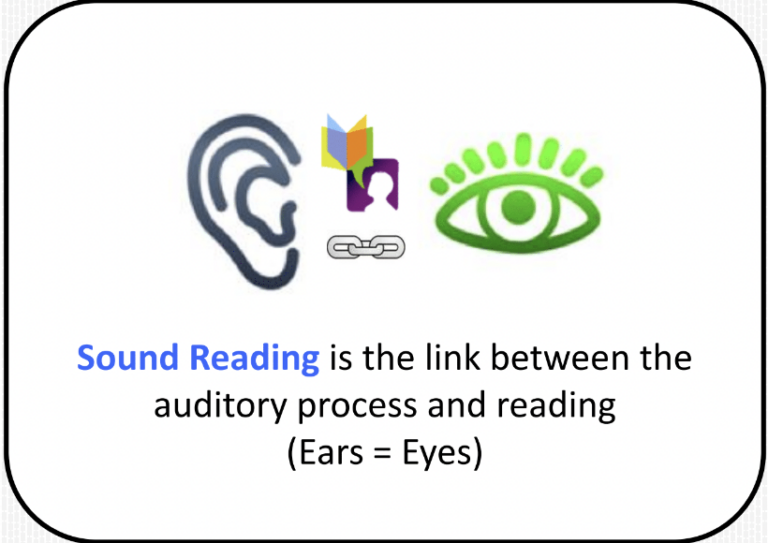




Only Sound Reading triggers the 3 areas of the brain that ensure reading success.
Sound Reading is for anyone who wishes to read naturally. Developed by a team of
educators and researchers frustrated with existing reading instruction, from phonics
to whole language, Sound Reading is guaranteed to have your child reading for
enjoyment and meaning.
Sound Reading combines the best in current reading research with ten years
of classroom experience to produce dramatic results in weeks — not years.
The secret to this success is the emphasis we place on keeping students
motivated, as well as on cutting edge instructional methods. Sound Reading is
fast, fun and highly effective even for disenchanted teens who have struggled
for years.
- Broadest Foundation — Sound Reading software focuses on more than just phonics. Reading difficulties, including struggles with learning phonics, are caused by listening problems, or auditory blind spots. Sound Reading develops the listening skills that allow natural readers to pick up reading so easily. Your child will read accurately and fluently.
- Full Phonemic Awareness — to be able to read the complex words of the English language, every reader needs to hear all the sounds in every word. Only Sound Reading’s innovative phonemic awareness activities are proven to be effective with teens.
- Boost in Grade Levels — Grade-level reading is just the beginning. Only Sound Reading boosts comprehension, fluency and word reading scores to above grade-level. No other reading intervention has documented this level of success.
Sound Reading is:
- 15 hours of software practice that develops listening, phonemic awareness and fluency skills. Students play over 25 brief, engaging activities that develop listening, phonemic, fluency and “fast phonics.”
- 15 hours of reading practice in our groundbreaking format that strengthens the decoding and fluency skills of the software and builds stamina and comprehension skills.
See how Sound Reading has turned tens of thousands of struggling readers into natural, motivated readers.
-
"I use Sound Reading Solutions because it works. It is the best complete phonemic awareness program on the market. It incorporates brain research and how the brain organically uses this material to create the pathways for reading."
Lynn T. Lovdal, River Valley Community
Athens, Ohio -
"Our tutors like SRS's easy-to follow structure. We see big gains in reading ability!"
J.D., Costco Volunteer
Atlanta, Georgia -
"It [Sound Reading Solutions] helps students improve sound recognition and sound blending automatically. Their ability to manipulate sounds greatly improves."
Marlene Lambert, Stony Brook Elementary
Pennington, New Jersey -
"Sound Reading has provided a systematic approach to develop phonemic and phonological awareness skills in a user-friendly format for both professionals and students."
Kay Morrison, Kettering Elementary School
Ypsilanti, Michigan -
"My students gained two and three grade levels in reading, more importantly they read with ease and are excited about considering themselves readers for the first time in their lives."
Lynn T. Lovdal, River Valley Community
Athens, Ohio

Start your child at the front of the class with Hop, Skip and Jump.

Whether you need to catch up or get ahead, Boost is for you.

Sound Reading's innovative software and groundbreaking reading practice is the simplest way to read English.
Nearly 98% of reading is actually an auditory process - meaning that strong listeners are also strong readers.
Bruce Howlett's (the founder of Sound Reading Solutions) passion for helping people to read comes from his experience as a dyslexic student. "I didn't read until I was in third grade and then only very simple books. I couldn't write a coherent sentence in fifth grade and failed English twice in high school." He managed to get through college in the 70's with the help of typists, who would charge him twice the going rate to fix spelling and grammatical issues.
Howlett spent a dozen years working as a researcher at Cornell University. His interest in reading difficulties was piqued when he went to teach high school science courses to a class of emotionally disturbed high school students. Only one student could read. He decided to research the reading difficulties from a scientific viewpoint and ignore the many belief systems that permeate reading instruction.
> Read More